NVIDIA BlueField-4 is less flashy than a GPU, but it is a useful clue to the next bottleneck in AI servers. Agentic inference can turn one user request into a chain of model calls, tool calls, retrieval steps, memory lookups, security checks, and logs. Fast GPUs are not enough. If networking, storage, CPU orchestration, and KV-cache movement slow down together, overall token throughput falls.
In a July 2026 technical post, NVIDIA described how BlueField-4 DPUs, Vera BlueField-4 STX Storage Processors, and DOCA software fit into the data path of AI factories. As AI server bottlenecks move from individual boxes to data-center-scale systems, the DPU becomes part of the inference pipeline rather than a peripheral.
Background
The NVIDIA Technical Blog says BlueField-4 integrates up to 800 Gb/s Ethernet or InfiniBand, a 64-core NVIDIA Grace CPU, PCIe Gen6, and high-bandwidth LPDDR5X memory. NVIDIA also says it doubles networking bandwidth over BlueField-3, delivers up to six times more compute performance, four times the memory capacity, and more than three times the memory bandwidth.
| Bottleneck | Traditional response | What BlueField-4 targets |
|---|---|---|
| Networking | Host CPU plus NIC | Routing, isolation, and acceleration on the DPU |
| Security | Application or host-layer inspection | Policy enforcement in the data path |
| KV cache | Recompute when GPU memory runs short | Optimized movement, storage, and reuse |
| Observability | After-the-fact log analysis | Telemetry in the infrastructure path |
How it works
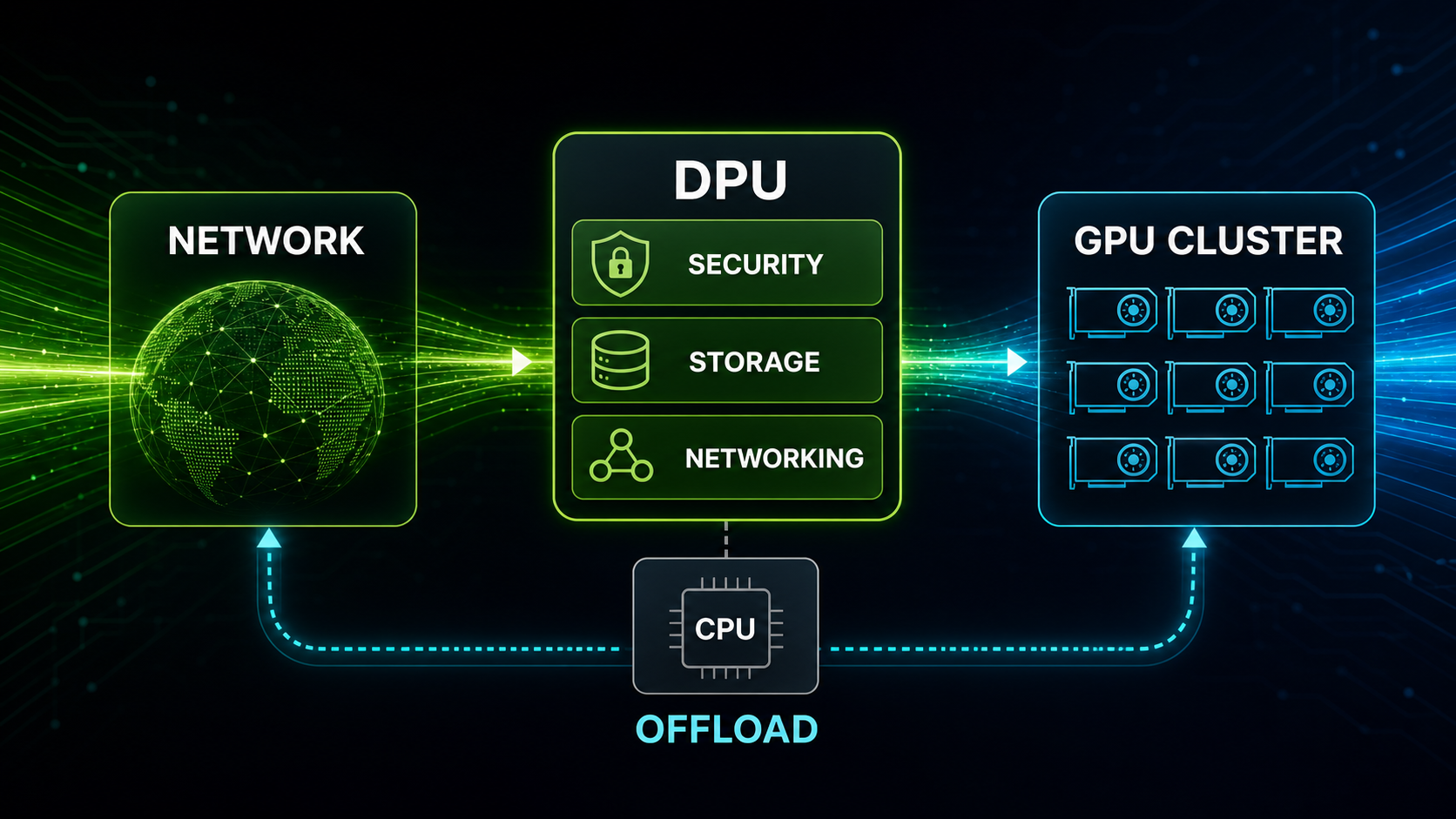
A DPU is a data processing unit. It offloads parts of networking, storage, security, and telemetry that a host CPU might otherwise handle, letting CPUs and GPUs focus on their primary work. The effect grows in agentic AI. A single user question may split into dozens of tool and retrieval steps, and each step creates small movements of data and permission checks.
KV cache is especially important for long-context inference. When a model reads a prompt, it produces intermediate attention state that can be reused instead of recomputed. But if GPU memory is constrained, systems must evict cache, recompute it, or move it to another tier. The NVIDIA DOCA platform overview shows how NVIDIA treats this cache and AI-native storage as an infrastructure problem. That means AI infrastructure cloud competition is expanding beyond GPU supply into data-movement design.
Architecture
The first image shows a separate infrastructure-processing layer in front of GPU servers. The second shows KV cache from a long conversation moving between GPU memory, a storage processor, and the network for reuse. The key point is that inference performance is not determined by matrix math alone.
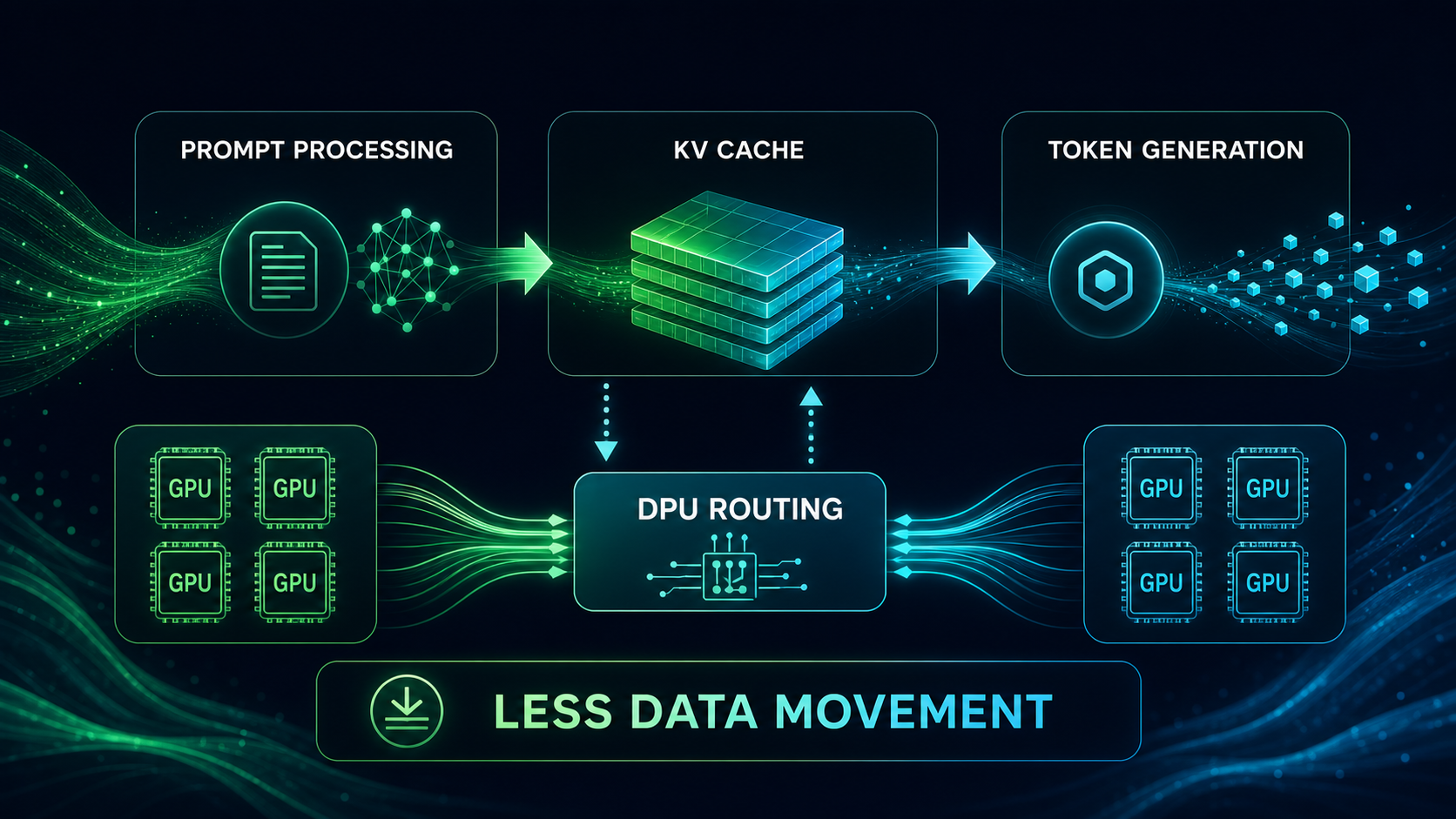
In an AI factory, GPU utilization and cost per token are outcomes of infrastructure design. A DPU is closer to a redesign of the inference data path than to a simple network card.
Checkpoints
BlueField-4’s numbers are impressive, but real gains depend on the software stack and deployment architecture. DOCA services, storage platforms, and orchestration have to fit together; inserting a DPU alone does not remove every bottleneck. KV-cache sharing also raises strict security and isolation questions. Context residue must not leak across tenants or requests.
BlueField-4 ultimately shows that AI server competition is moving from “faster GPUs” toward “data paths that keep GPUs busy.” Teams operating large-scale inference should evaluate networking, cache, and security offload alongside model choice.




No comments:
Post a Comment