Runway Gen-4.5 shows that AI video competition is moving beyond resolution and style toward physical accuracy and control. AI video physical accuracy is becoming a useful search phrase because it describes the practical production problem more precisely than generic model ranking. Runway presents Gen-4.5 as a leading model in motion quality, prompt adherence, and visual fidelity, and says it reached 1,247 Elo at the top of the Artificial Analysis Text to Video benchmark. The company also says it maintains Gen-4’s speed and efficiency while bringing existing control modes such as Image to Video, Keyframes, and Video to Video to Gen-4.5.
The earlier Runway Gen-4 discussion centered on character and world consistency. Runway’s Gen-4 announcement framed the ability to keep the same subjects and world consistent across scenes as the central advance. Gen-4.5 adds another question: how long can object weight, collisions, liquid motion, hair, fabric, and other details remain believable over time? If AI video generation is to move from impressive short clips into production pipelines, that is the practical bottleneck.
Background
Runway says Gen-4.5 advances both pre-training data efficiency and post-training techniques. It emphasizes dynamic action generation, temporal consistency, and precise control across generation modes. Runway also says inference runs on NVIDIA Hopper and Blackwell GPUs, and that the model was developed on NVIDIA GPUs across research, pre-training, post-training, and inference.
Errors in video are more visible than errors in text. An awkward sentence can be rewritten, but a disappearing cup or an effect appearing before its cause is immediately noticeable. That is why Runway’s emphasis on physical accuracy makes sense. Creators do not only need a beautiful frame; they need motion that remains believable as the scene unfolds.
| Evaluation axis | Gen-4.5 emphasis | Production meaning |
|---|---|---|
| Motion quality | Weight, force, and believable movement | Drafting action scenes |
| Prompt adherence | Complex scene structure | Keeping storyboard intent |
| Temporal consistency | Details preserved over time | Lower regeneration cost |
| Control modes | Keyframe, image, and video inputs | Combining with existing assets |
Principle
To understand Runway Gen-4.5, it is not enough to imagine text turning directly into video. A prompt defines a scene goal, and the model must estimate objects, characters, camera movement, and time together. It then generates motion while trying to keep the same world coherent across frames. This is why the language of world models appears so often: objects on screen must continue to be the same objects in the next moment.
Consider a prompt where water fills a rusty bucket and a paper boat floats along a stream into a house. The model must coordinate water flow, bucket position, buoyancy, and camera motion. If just one element fails, the video starts to look like a toy scene. Runway says Gen-4.5 improves how liquids, surface detail, hair, and material weave remain coherent through motion and time.
AI video quality is less about whether the first frame is beautiful and more about whether the rules hold as time passes. Physical accuracy, object permanence, and cause-and-effect order are now core production criteria.
Structure
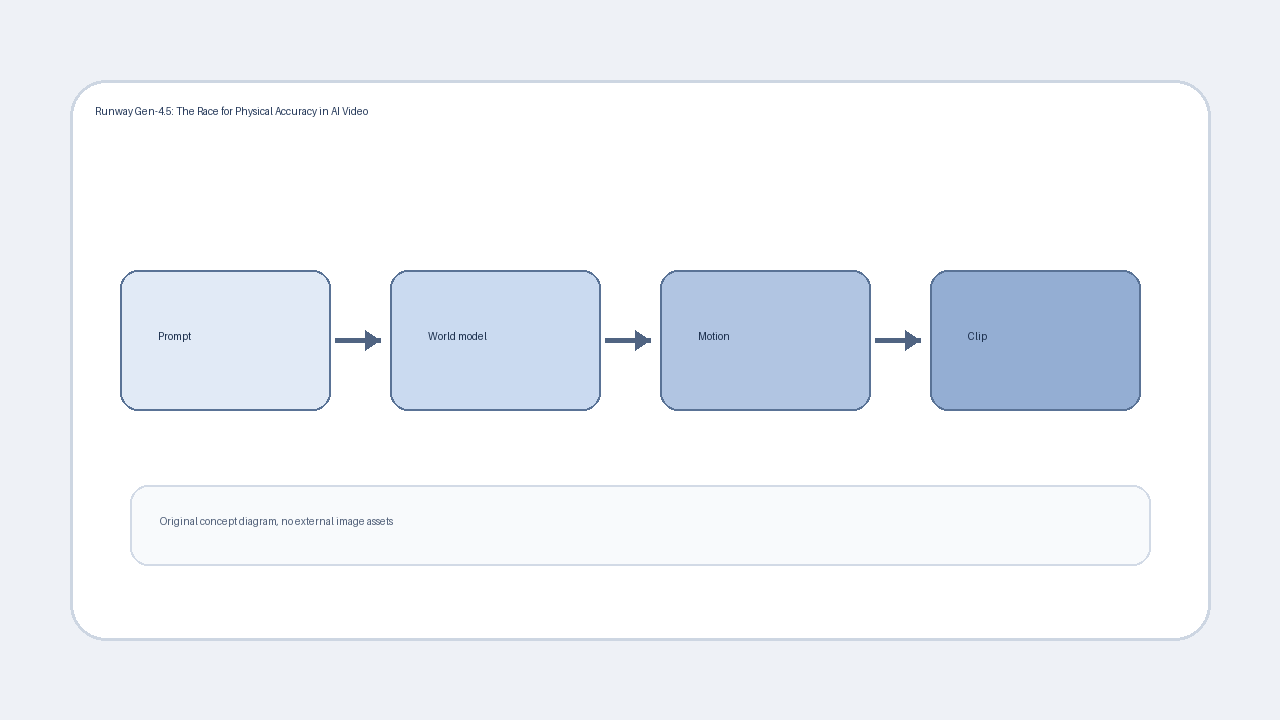
Prompt is the scene description. World model is the relationship among characters, objects, and environment. Motion is how those elements evolve over time. Clip is the final video. The more detailed the prompt, the more constraints the model must satisfy, and creators narrow the result through repeated iterations.
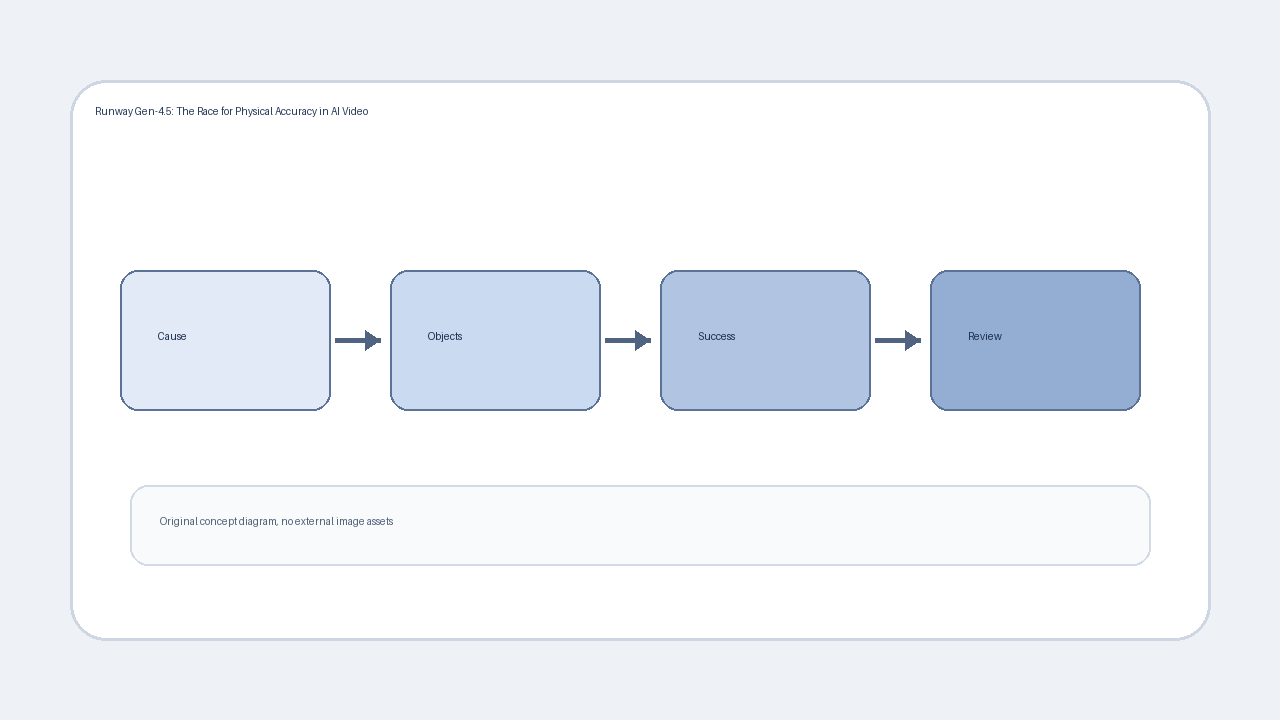
The second diagram summarizes limitations Runway itself highlights. Cause refers to the order of cause and effect. Objects refers to object permanence. Success refers to the tendency for actions to succeed too easily. Review is the human editing stage that checks whether the shot is usable.
Checkpoints
A benchmark lead does not mean leadership in every production situation. The Artificial Analysis Text to Video score is useful, but advertising, film, education, and game cinematics each have different constraints.
Runway’s stated limitations matter. Effects can precede causes, occluded objects can disappear, and difficult actions may succeed too often. Better physical accuracy does not mean the model has become a perfect simulator.
Rights management becomes more important as realism rises. If outputs resemble specific people, places, or brands, likeness and licensing issues can become production risks.
Runway Gen-4.5 is not simply a promise that “anyone can make movies.” Its practical value is narrower and more useful: faster scene drafts, storyboard testing, and mood exploration. Combined with voice agents and real-time interfaces, the same direction could become a broader media production workflow. Final use still requires human review for physics errors, object consistency, and rights concerns.




No comments:
Post a Comment