AI server competition used to be explained mainly as a question of which GPU was faster. As large-scale inference and agentic workloads grow, the bottleneck is moving from an individual GPU to the entire rack. Interconnects, host CPUs, memory bandwidth, networking, and software runtimes all have to line up before token throughput and power efficiency appear in production. AMD Helios, announced at Advancing AI in July 2026, is a useful marker of that shift.
AMD described Helios as a rack-scale solution that combines 72 AMD Instinct MI455X GPUs, 18 sixth-generation EPYC “Venice” CPUs, Pensando networking, and ROCm software. According to AMD’s announcement, AMD Helios can deliver up to 30% more tokens per dollar than the leading competitive solution. The company also claimed that MI455X delivers 34 times higher token throughput than MI355X, based on its own measurements. Those numbers should be read with the vendor’s test conditions in mind, but the strategic point is clear: the unit of competition is expanding from the GPU board to the rack and the software stack around it.
Background
AI demand in data centers is spreading beyond training into inference and agent execution. A single user request can branch into retrieval, code execution, tool calls, image analysis, and long-context state. In AI server bottlenecks, the important metrics are not only peak performance but sustained throughput, density within a power envelope, network latency, and operational tooling.
That is why AMD’s mention of ROCm.ai matters alongside Helios. ROCm is AMD’s open software platform for its GPUs, and ROCm.ai was introduced as a development platform for building, optimizing, and deploying GPU software faster. AMD’s separate MI400 Series update also positioned the Instinct line for inference and HPC workloads. Better hardware alone is not enough; model serving and developer tooling have to be convincing before cloud providers and AI labs can move real workloads.
| Component | Role in the Helios announcement | What readers should watch |
|---|---|---|
| MI455X GPU | Acceleration for large-scale inference and training | Throughput by model, precision, and serving setup |
| EPYC Venice CPU | Host node and data feeding layer | Memory and I/O capacity that keeps GPUs busy |
| Pensando networking | Scale-up and scale-out connections | Latency and stability across racks |
| ROCm and ROCm.ai | Development, optimization, deployment | Framework compatibility and operational effort |
How It Works
A rack-scale AI system is not simply “a computer with many GPUs.” It is closer to a large inference factory. When a user request arrives, tokenization, prefill, decoding, cache management, tool calls, and post-processing all happen in sequence. GPUs handle matrix operations, but CPUs schedule requests, networking moves data among accelerators, and the runtime adjusts batch size and memory use.
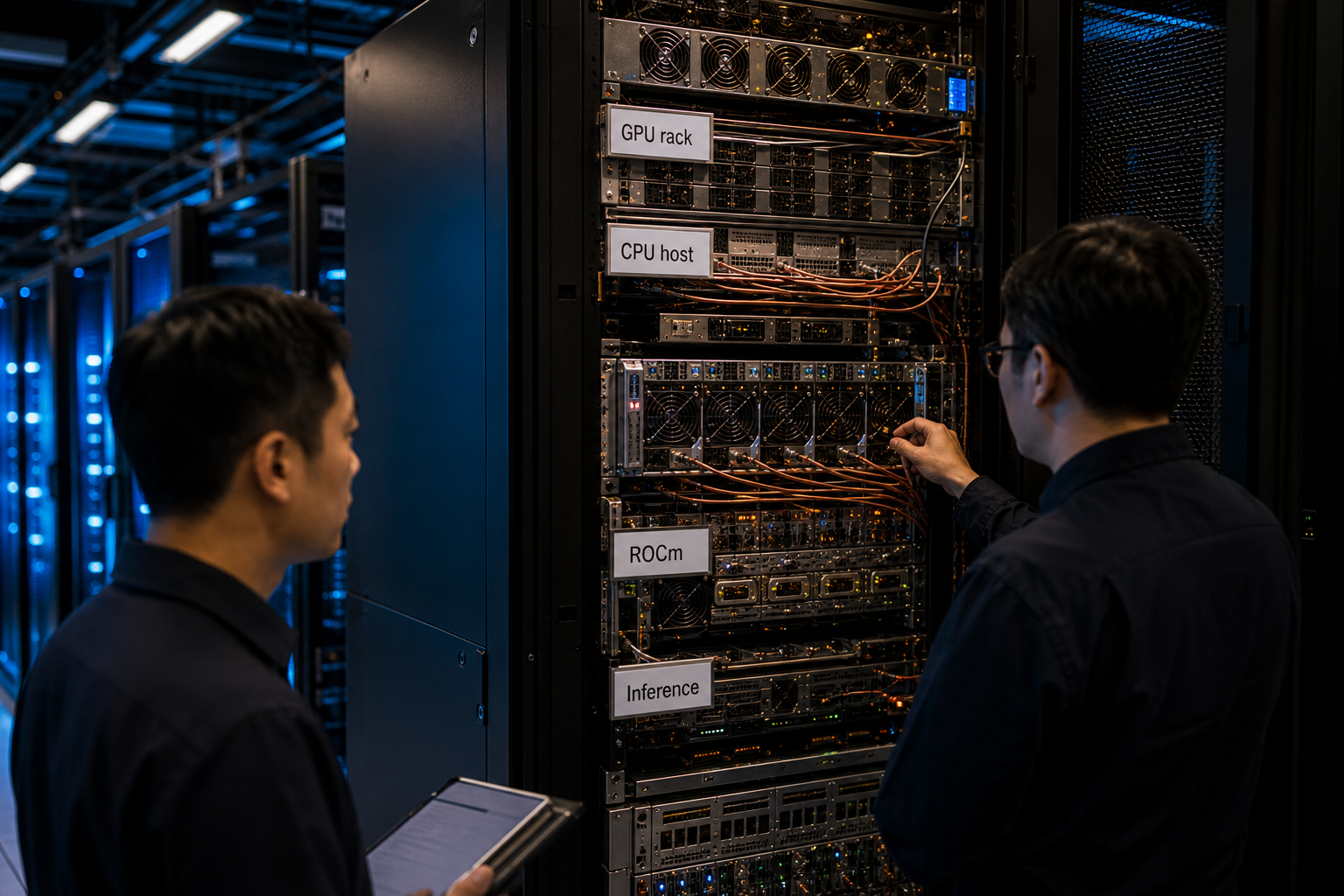
For example, imagine an enterprise chatbot that goes beyond answering text and also searches documents, generates tables, and executes code. As each request gets longer, KV cache and memory bandwidth matter more. As concurrent users increase, batching and queue management become decisive. The cost is shaped less by the peak performance of one GPU and more by how efficiently multiple GPUs are split, scheduled, and recombined. A rack-level design such as Helios tries to optimize those bottlenecks together from the start.
Architecture
Another axis in AMD’s announcement was “physical AI.” The company discussed Kria AI solutions, Ryzen AI Embedded X100 Series processors, and a robotics developer platform as a path for cloud AI to move into machines and industrial equipment. That also signals that AI semiconductor demand is not confined to data centers.
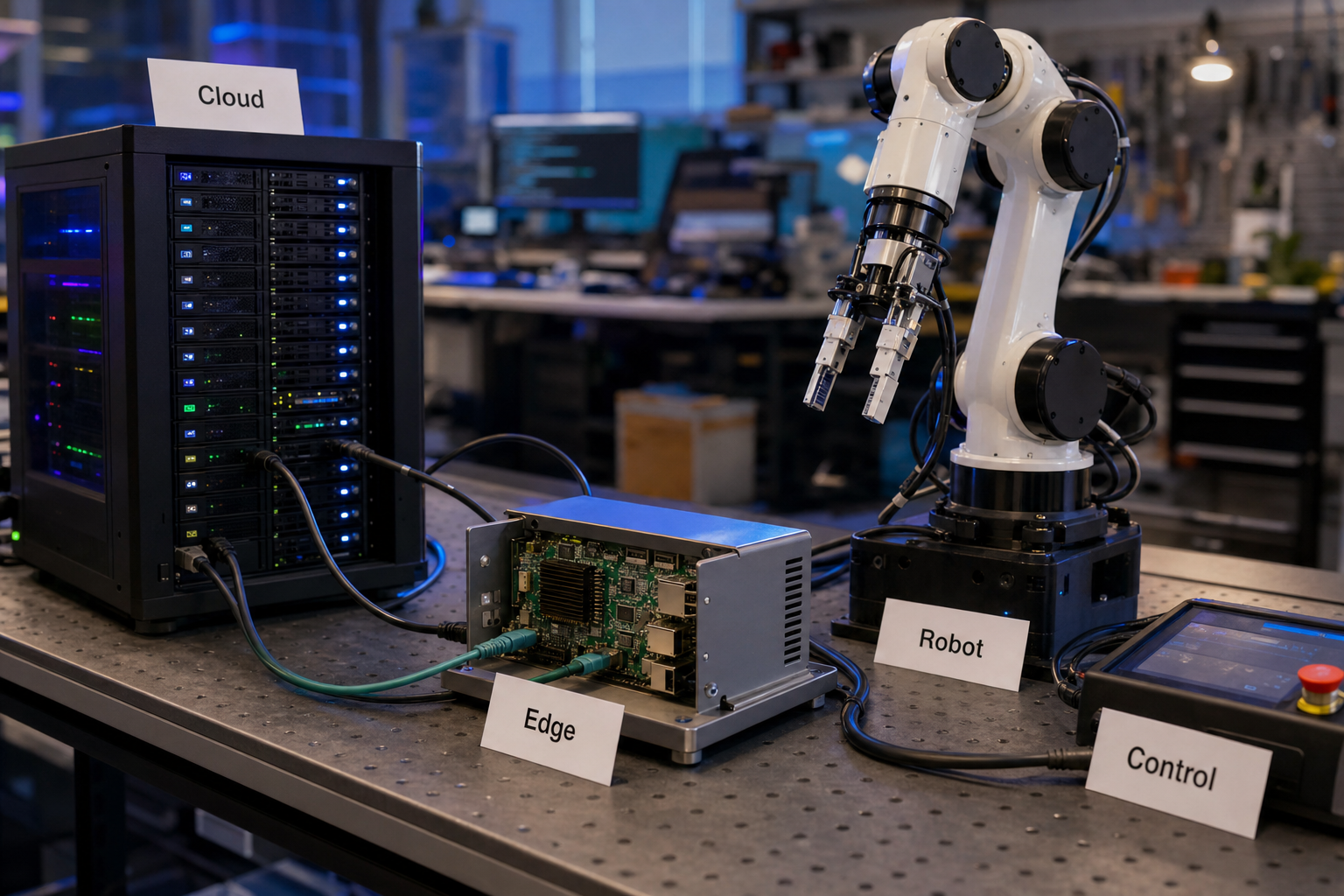
In simplified form, the upper layer is a Helios-style rack that trains and serves large models, while the lower layer is made of embedded and edge platforms that control sensors and robots on site. The bridge between the two includes model compression, latency budgets, observability, and secure updates. In factories or logistics centers, equipment cannot simply stop when internet access is unstable, so deciding what runs in the cloud and what runs locally becomes a core product-design decision.
Checkpoints
- AMD’s claims of up to 30% more tokens per dollar and 34 times higher MI455X token throughput depend on the company’s stated test conditions. Teams should not assume the same ratio applies to every model, precision, or batch size.
- The ROCm ecosystem is expanding quickly, but organizations with CUDA-centered code and operating habits still need to evaluate migration cost.
- Rack-scale systems must be compared by total cost, including power, cooling, networking, and support contracts. GPU sticker price alone can obscure real economics.
- Physical AI extends safety responsibility beyond software. In robotics, industrial equipment, health care, and logistics, a model error can become a physical incident.
The main point of AMD Helios is not just that AMD has another fast GPU platform in the same market as NVIDIA. It is that AI infrastructure is becoming an integrated competition across racks, networking, software, and edge devices. For enterprises, the useful question is not a single benchmark line. It is whether their models, latency targets, power limits, and developer ecosystem fit the stack.




No comments:
Post a Comment