Intel once came close to being synonymous with the PC processor, but that description misses the transformation the company is attempting in 2026. Intel sells processors such as Core and Xeon while trying to offer advanced process technology and packaging to outside customers through Intel Foundry. Its history of combining design and manufacturing is both an asset and a structure in which factory investment and process delays can weigh heavily on earnings.
This Intel company review is not a simple CPU performance comparison. It examines whether Intel under CEO Lip-Bu Tan can connect PC and server cash flow, the Intel 18A process, U.S. manufacturing, and an external foundry business into one turnaround strategy. The latest detailed financial baseline is the official first quarter ended March 28, 2026, while the 2025 Form 10-K provides the annual operating structure.

Intel is fundamentally a dual product-and-factory business
The core of Intel Products is the Client Computing Group, or CCG, and Data Center and AI, or DCAI. CCG covers Core processors and commercial PC platforms for notebooks and desktops, while DCAI includes Xeon CPUs and data-center products. PCs now compete on an AI experience combining the NPU, GPU, and CPU as well as performance and battery life. GPUs may command attention in data centers, but CPUs still run operating systems, process data, and coordinate networks and accelerators.
Intel Foundry combines technology development, wafer fabrication, assembly and test, and advanced packaging. The difficulty is that most Foundry revenue still comes from manufacturing Intel's own products. According to the 2025 Form 10-K, external revenue was only $307 million of Intel Foundry's $17.826 billion in 2025 revenue. Until the outside-customer business becomes material, internal volume supports factory utilization while the competitiveness of Intel's products determines much of the factory economics.
| Business layer | Representative assets | Customer value | Intel's challenge |
|---|---|---|---|
| Client | Core Ultra, vPro, Arc | PC performance, power, and local AI | Compete with Arm, AMD, and Apple for upgrades |
| Data center | Xeon 6 and 6+, networking and acceleration | General compute and AI-system coordination | Defend CPU budget in a GPU-centered market |
| Manufacturing | Intel 18A, Fab 52 | Leading-edge U.S. logic production | Stabilize yield, cost, and schedules |
| Packaging | Foveros and advanced packaging | Integrate dissimilar chiplets | Win an external design ecosystem |
| Software | oneAPI, OpenVINO, and tools | Develop and deploy across compute engines | Preserve consistency across hardware generations |
This dual structure differs from the fabless NVIDIA AI factory strategy. NVIDIA concentrates on ecosystems and system design while outsourcing fabrication; Intel is responsible for both product demand and factory utilization. If manufacturing stabilizes, however, Intel can fabricate customer chips while feeding process and packaging knowledge into its own products quickly. The advantage and the risk have the same root.
Intel 18A tests transistor, power-delivery, and packaging changes together
Intel 18A is more than a process name with a smaller number. First, RibbonFET is a gate-all-around structure in which the gate surrounds the channel on several sides, improving current control as dimensions shrink. Second, PowerVia is backside power delivery, separating signal wiring and power delivery onto different sides of the wafer. Third, Foveros combines chiplets with different functions vertically and horizontally inside one package to build a complete system.
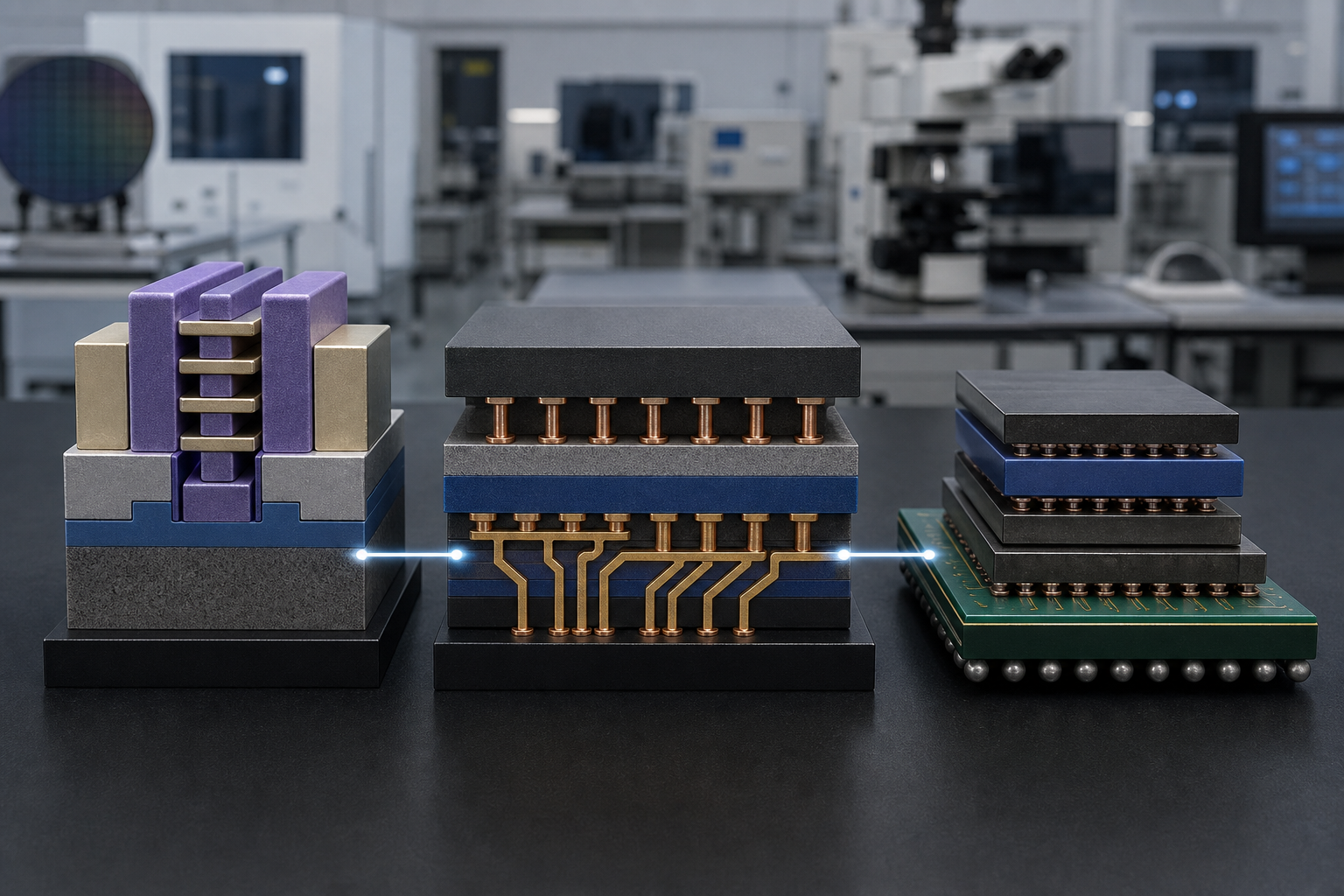
Intel's official 18A explanation states targets of up to 15% better performance per watt and 30% higher chip density than Intel 3. These are company process claims, so performance, power, and manufacturing cost in an actual notebook or server still need to be tested by design, yield, package, and memory configuration. A process name does not automatically guarantee a superior finished product.
The first symbolic product is Core Ultra Series 3, code-named Panther Lake. In this Panther Lake AI PC, Intel lists up to 16 performance and efficiency cores, an Arc GPU with up to 12 Xe cores, and up to 180 platform TOPS, with broad availability beginning in January 2026. Intel Pro Day 2026 described more than 125 designs spanning enterprises, education, government, and small and medium businesses. The meaning of an AI PC depends less on the TOPS number than on whether meeting summaries, security, and content-creation workloads become repeat uses within battery and privacy constraints.
In servers, Xeon 6+ Clearwater Forest extends the 18A validation. Intel lists up to 288 efficiency cores and a 17% instructions-per-cycle improvement from the previous generation, targeting processing density and energy cost for cloud providers and telecom operators. Stable client and server shipments on the same process would become evidence of yield and schedule discipline for outside customers. Delays or cost problems would damage product and Foundry credibility at the same time.
The competitive field is broad. Apple, AMD, and Qualcomm pressure PCs through power efficiency and on-device AI. AMD EPYC and custom Arm CPUs compete for data-center share. TSMC and Samsung Foundry compete in manufacturing. TSMC A16 also makes backside power delivery central to its proposition, so Intel must prove differentiation through customer designs, yield, delivery, and total cost rather than technology announcements alone.
Q1 2026 growth is encouraging, but Foundry economics remain unproven
In Intel's official Q1 2026 results, revenue was $13.6 billion, up 7% year over year. CCG revenue rose 1% to $7.7 billion, while DCAI rose 22% to $5.1 billion. Total Intel Products revenue was $12.8 billion, and Intel Foundry segment revenue, including intersegment transactions, increased 16% to $5.4 billion. Operating cash flow for the quarter was $1.1 billion.
| Official Q1 2026 metric | Result | What it means |
|---|---|---|
| Consolidated revenue | $13.6 billion | 7% year-over-year growth |
| CCG revenue | $7.7 billion | Up 1%; the PC recovery remains gradual |
| DCAI revenue | $5.1 billion | Up 22%; servers are the growth engine |
| GAAP gross margin | 39.4% | Improved 2.5 percentage points year over year |
| GAAP net loss | $3.7 billion | Includes restructuring and other items; profitability is not restored |
| Non-GAAP net income | $1.5 billion | The gap between adjusted and reported results matters |
| Q2 revenue outlook | $13.8–14.8 billion | Company guidance, not a completed result |
The GAAP operating loss was 23.1% of revenue and the net loss was $3.7 billion, while the non-GAAP operating margin was 12.3% and non-GAAP net income was $1.5 billion. The large gap reflects restructuring, investment and equity remeasurement, and other adjustments. Looking only at non-GAAP results can conceal real costs, while treating one GAAP quarter as the whole operating trend can miss improvement. Cash flow and segment economics belong beside both measures.
The annual Foundry figures are more sobering. Intel Foundry generated $17.826 billion in 2025 revenue but incurred $28.144 billion in cost of sales and operating expenses, producing a $10.318 billion operating loss. That improved from a $13.291 billion loss in 2024, yet Intel also recorded $849 million of 2025 intersegment inventory reserves related to products made during the early Intel 18A ramp. Until yield gains and external customer growth appear in financial results, Foundry is both a strategic option and a major capital burden.
Intel Foundry revenue includes substantial transactions with Intel Products. Q1 2026 Foundry revenue of $5.4 billion should not be read as independent external foundry sales, and the 2025 figure of $17.826 billion is not directly comparable with TSMC-style external revenue.
Final assessment includes execution, customer, AI, and capital risk
The first risk is process execution. An advanced node requires design rules, equipment, materials, yield, and packaging to work together. Even after initial shipments, low yield can disrupt cost and supply. Intel must demonstrate repeatability through Panther Lake volumes, Clearwater Forest delivery, external customer tape-outs, and repeat orders.
The second risk is customer conflict. Foundry customers want their chip designs and launch schedules isolated from competing Intel Products organizations. They need access controls, fair pricing, credible capacity priorities, and confidence in the long-term roadmap. The internal products that fill factories can become a perceived conflict of interest for an outside customer.
The third is AI positioning. Intel has a credible argument that the CPU remains an essential general-compute layer in every AI system, but developer attention and accelerator budgets are concentrated around NVIDIA and competitors. In the AI semiconductor market, Intel's realistic contest is not one GPU alone. It is a package of Xeon, AI PCs, networking, packaging, and customer-chip manufacturing. A bundled strategy works only when every important component is competitive enough.
The fourth is capital and policy. Leading-edge U.S. manufacturing can provide supply-chain resilience and public-policy support, but factory construction, depreciation, and utilization are expensive. If demand arrives late or customer wins are insufficient, a strategic asset becomes fixed cost. If geopolitical supply-chain restructuring accelerates, the ability to offer design, manufacturing, and packaging in the United States could instead become a differentiator.
Intel is therefore neither merely an old PC CPU company nor an already completed global foundry. Q1 2026 revenue growth of 7% and DCAI growth of 22% show that the product base remains alive. The $10.318 billion 2025 Foundry operating loss and small external revenue show how far the transition still has to travel. The indicators to watch are 18A product yield and shipment volume, external Foundry revenue and customer count, CCG share, DCAI growth, gross margin, and cash flow relative to capital spending. If those measures improve together, Intel's integration of design and manufacturing can become a competitive advantage again rather than a burden.